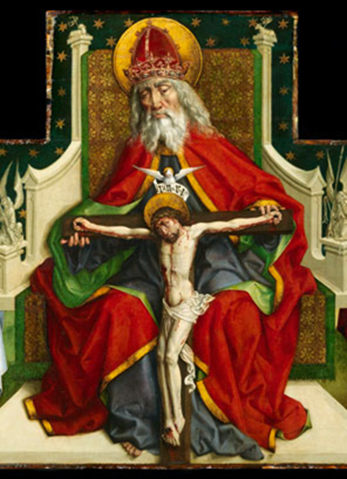
Doctrine of the Trinity
Dr Alison Walker, with additions
- 7 minutes read - 1471 wordsPre-reading
God exists as three persons
– Father, Son, and Holy Spirit –
and each is fully God, and there is one God.
Would it matter if God wasn’t triune?
Karl Rahner, 1967
'The treatise on the Trinity occupies a rather isolated position in the total dogmatic system. To put it crassly, and not without exaggeration, when the treatise is concluded, its subject is never brought up again. Its function in the whole dogmatic construction is not clearly perceived. It is as though this mystery has been revealed for its own sake, and that even after it has been made known to us, it remains, as a reality, locked up within itself. We make statements about it, but as a reality it has nothing to do with us at all.'
The Trinity
Frustrated that it does not have further significance on other doctines (soteriology) and church life
Split of Eastern and Western churches over the phrase filioque
Where does the Trinity appear in the Bible?
Genesis 1; as explained by John
Matthew 3:16-17: Baptism of Jesus
John 14:9: If you have seen me, you have seen the Father
John 16:7: If I do not go away, the Advocate will not come to you
Matthew 28:19: Go and make disciples in the name of all three
1 Corinthians 13:13: Grace
1 Corinthians 1:21-22: God establishes us in Christ and gives Spirit as first installment
Not fully formed doctrine of trinity but proto-trinitarian doctrine that needs more unpacking
the word 'trinity' is not in the Bible
the Bible does not explicitly teach trinity, at least as expressed in the creeds
trinity is a deduced doctrine
according to the early church, the trinity was an essential doctrine
very early adoption of worship of Jesus, not just following him
Larry Hurtado, NT scholar
> ‘…an exalted significance of Jesus appears astonishingly early in Christian circles. Well within the first couple of decades of the Christian movement (i.e., ca. 30‐50 C.E.) Jesus was treated as a recipient of religious devotion and was associated with God in striking ways. In fact…we probably have to posit a virtual explosion of devotion to Jesus toward the earlier end of this short period.'
Lord Jesus Christ
monolatry (compare with idolotry)
OT has the Jews worshiping 'the one true God' but no denial or disbelief in other gods
Richard Baukham
‘Jews understood their practice of monolatry to be justified, indeed required, because the unique identity of YHWH was so understood as to place him, not merely at the summit of a hierarchy of divinity, but in an absolutely unique category, beyond comparison with anything else. Worship was the recognition of this unique incomparability of the one God. It was the response of YHWH’s self‐revelation as the sole Creator and Ruler of all.'
God Crucified
remarkable that worshiping Jesus raises no conflict with Jewish believer’s monotheism
though not expressed in these terms, perhaps the early church held an 'Economic Trinitarianism' belief.
Economic trinitarianism
God is trinity, but only with respect to the ‘economy' of creation;
If there were no economy, then God would not be triune;
Being ‘triune' is the result of a choice on God’s part
Justin Martyr (ca. AD 100-165) writes: ‘[the Son] was begotten of the Father by an act of will'
The Arian Controversy (4th century)
‘And before [the Son] was begotten or created or defined or established, he was not.' --Arius
Arian slogan: ‘there was a time when he was not'
Interpreting Colossians ('First-born of all creation')
Creator/Creature distinction
----------------------------
             |
    Creator  | Creature
   Uncreated |  Created
‘Therefore, beloved and brothers united in soul, avoid those who dared such things against Christ, who tear up Christianity to pieces in public, who strive to parade it before courts of justice, who as much as possible aroused persecution on us in peace, and who cut the very sinews of the ineffably mystery of Christ’s generation.'
p. 44
Council of Nicea, 325
The council produces a confessional statement, a ‘creed.'
It states that the son is ‘of the same substance' as the Father.
‘We believe in one God, Father Almighty Maker….and in one Lord Jesus Christ, the Son of God, begotten as only‐begotten of the Father, God of God, Light of Light, true God of true God, begotten not made, consubstantial with the Father [homoousion tō patri]…and in the Holy Spirit.'
Homoousious (of the same substance)
Homoiousious (of similar substance)
Council of Constantinople, AD 381
Second major ecumenical council
produced the famous Nicene‐Constantinopolitan Creed which many churches recite today.
It is sometimes referred to as ‘Nicaea 381.'
Reinstalls the ‘homoousios' terminology
Extended commentary on the status of the Holy Spirit to combat ‘pneumatomachians': ‘[We believe] in the Holy Spirit, the Lord and life‐giver, who proceeds from the Father, who is worshipped and glorified together with the Father and the Son…'
Athanasius, Bishop of Alexandria, 327-373
Gospel/Salvation issue
Only God saves humanity from its predicament
Now this is the catholic faith: That we worship one God in trinity and the trinity in unity, neither blending their persons, nor dividing their essence. For the person of the Father is a distinct person, the person of the Son is another, and that of the Holy Spirit, still another. But the divinity of the Father, Son, and Holy Spirit is one, their glory equal, their majesty coeternal.
Many other minor councils, creeds and debates
Classical doctrine of the Trinity
Tertullian suggested that the Trinity be understood according to the formula ‘three persons, one substance'
the problem with this is that latin persona means 'mask' which led to 'modalism'
Chronological modalism
Father (Old Testament)
Son (New Testament)
Spirit (Church)
Functional modalism
Father (Creation)
Son (Redemption)
Spirit (Sanctification)
Problem of translating between Latin West and Greek East
Post Constantinople, emphasised mia ousia, treis hypostases
Ultimately landed on this terminology
Trinitas – Trinity
Persona – Person, Mask, Role (Greek – hypostasis)
Substantia – Substance, essence (Greek – ousia) but in order to say this, the Cappadocean Fathers had to invest a brand new meaning into the term ‘hypostasis.'
This fills out the meaning of the confusing term ‘homoousios.' In light of Nicaea 381, ‘of the same substance' now means that Father, Son and Spirit are all ‘God' because they all share the properties of divinity equally.
Nevertheless, the three are distinct ‘hypostases' or ‘persons'
RELATIONS OF ORIGIN
The Father is ‘the one who begets the Son and spirates the Spirit'
The Son is the ‘the one who is begotten by the Father [and spirates the Spirit]'
The Spirit is ‘the one who proceeds from the Father [and the Son]'
‘The three so called persons, [Augustine] said, are not something different, each in himself. They are different only in their relation to each other and to the world.'
‘What Augustine means is that the designations “Father,” “Son,” and “Holy Spirit” do not express either a substantial, or a quantitative, or a qualitive difference, because these do not even exist. What the concept of the persons expresses is, rather, an eternal relation.'
Summary
God is three hypostases and one ousia. However, God’s *hreeness is not like our idea of three persons [persona], *or is God’s oneness like our ideas of one essence [substantia].
All share fully in God’s ousia from all eternity. Language of *begotten' and ‘generation' does not carry any temporal significance.
Not parts (or one-third) of God.
Not simply different ‘modes' or appearances of the one God in time.
Modern issues
Trinity as either:
Summative
Foundational
Rahner’s Rule:
‘The “economic” Trinity is the “immanent” Trinity and the “immanent” Trinity is the “economic” Trinity.’
The Trinity
‘economic Trinity’ = how God appears to us in the ‘economy’ of creation
‘immanent Trinity’ = how God is in himself
Torrance: There is no God hiding behind Jesus
Social Doctrine of the Trinity (recent = last fifty years!)
Jürgen Moltmann (The Trinity and the Kingdom)
John Zizioulas (Being as Communion)
Analytic Theology (building on modern philosophical analysis)
Problem is that this emphasises diversity or relationality over unity
As evidenced in [The Shack](https://www.amazon.co.uk/Shack-Wm-Paul-Young/dp/0340979496/ref=sr_1_1?crid=4ZCQEP39JZT9&keywords=the+shack&qid=1652817724&s=books&sprefix=the+shack%2Cstripbooks%2C94&sr=1-1)
[God and difference by Linn Tonstad](https://www.taylorfrancis.com/books/mono/10.4324/9781315675923/god-difference-linn-marie-tonstad)
Karl Barth: Revelational model of the Trinity
Barth’s maxim: God reveals himself as Lord
God – the one who does the revealing is God himself, particularly God the Father.
reveals himself – the content of what God reveals is not info about God, but actually God himself; this is the Son, or the Word of God.
as Lord – God is in control of the event by which he reveals himself; the facilitator of this transaction, the ‘perfector’ of God’s revelation, is the Holy Spirit.
Visualising the trinity