Stephenson Missiology
Tim Stephenson
- 19 minutes read - 3938 wordsOption 2) Fresh Expression in Each New Generation
In 2,500 words discuss how new forms of Church might engage with a consumerist culture whilst being true to the discipleship of Jesus. How might an ‘It-must-fit-me culture’ be discipled? Make reference to wider biblical and theological sources in your answer. Finally, discuss the implications of fresh expressions in the way that mission might be engaged in your current context? As you look at the insights for mission detailed by your mission audit, what actions will you be taking?
How engage consumerist / post-modern?
In this essay I will start by looking at the culture of the UK in the first quarter of the twenty first century and why consumerism is one of its most defining features. I will look in particular at the similarities and differences between this national picture and the culture of semi-rural North Wiltshire. Next, I will look at the nature of discipleship and how that conflicts with the 'it-must-fit-me' culture in important ways. This will provide the backdrop for a critical evaluation of the recent push for 'fresh expressions' of church to better address this culture. Finally I will look at what this has to say in my current context of Corsham and what initiatives I may take based on these insights.
Data consistently shows that the number of people self-declaring themselves Christian is dropping and shows no sign even of bottoming out. The British Social Attitudes survey in 2018 compared answers since its inception in 1983. In this period Christians declined from 66% to 38% with most of the change taken up by No religion (from 31% to 52%). [1] Census data shows similar trends with Christian and No religion reporting 46.2% and 37.2% in 2021 compared to 59.3% and 25.2% in 2011 and 72% and 6.4% in 2001 respectively. [2] [3]
Given such precipitous falls in church attendance within the UK there has understandably been an amount of navel gazing. Michael Moynagh is quick to conclude the issue is internal: 'Many clergy and lay people know that today’s church is not working, it is not connecting with people anymore.' [4] This is a natural human reaction from those who have devoted large chunks of their lives to the 'success' of the church. The authors of 'Fresh!' quote George Lings' analogy of contemporary Britain to the Exile as one that resonates for many. [5] This is a perspective I have heard more than once in my own context of North Wiltshire and often concludes that we should prepare ourselves for imminent persecution every bit as extreme as the people of Israel in Babylon.
I see three problems with these arguments. First, they extrapolate from a partial analysis. As the authors of 'Fresh!' continue, church has not suddenly become flawed or sinful, it has always been made up of sinful humans. As recently as Victorian England, church has been much larger and more influential but nonetheless often entangled in power politics, exploitation of the poor and racism. [6] In addition to any shortcomings of the church, there are strong external factors driving the current trend that simply weren’t there in previous eras including: materialism/ consumerism, powerful elites with a collective unbelief and a wider culture that is largely hedonistic. [7]
Secondly, the stance of the church is a choice to which we all contribute. We can be inward-looking, concentrating on protecting our identity and increasingly fearful, adopting a defensive posture. Or we can be bold, engaged and outward-bound, drawing confidence from Christ’s victory that we proclaim as already won. This is the same debate that Augustine engaged with the Donatists, arguing that church has a vital and transformative role to fulfil in wider society not merely to provide refuge for believers that are in Peter Brown’s memorable phrase, ‘immobilized by anxiety to preserve its identity’. [8] Not for the first time, I am encouraged that similar challenges have ben faced, and faced down, by the church through history.
But most importantly, this self-critical outlook espoused by Moynagh surely contains a limited view of God. One might argue, 'If this is the best He can do, no wonder few are convinced!' But that is to incorrectly conflate the mission of the church with the mission of God. In the much cited words of David Bosch 'mission is not primarily an activity of the church, but an attribute of God. God is a missionary God.' [9] Similarly, John Stott, has observed that 'he is a missionary God before we ever are a missionary church'. [10] The Bible provides us the definition of missio Dei starting with creation by a loving Father, drawing near to humanity in the incarnate Son and convinced, enabled and sustained through the Holy Spirit until the establishment of the Kingdom prophesied in Revelation. We are graciously allowed to participate in His own mission of seeking and saving the lost, but he’s not leaving it to this motley crew of sinners alone.
Moynagh concludes that if the problem is a mismatch between the church we have and a changed society then the solution is a changed church. If 'Amazon-ification', offering near limitless choice tailored to our precise desires and delivered ever faster is an accurate description of our consumerism, then surely church too must respond to this 'it-must-fit-me' pattern? Certainly, Mark Dever and Jamie Dunlop strongly disagree. Their thesis in 'The Compelling Community' is that only the supernatural power of God will build the church in a sustainable way. Seeking to do otherwise is not only a recipe for burning out our people but also a disservice to those attracted by such ministries since they embed a consumer view towards church. If a group that previously met my needs ceases to do so I should seek out a new one as 'it-must-suit-me' becomes 'whats-in-it-for-me'. Dever, summarising the Great Commission of Matthew 28, defines church as evangelism plus discipleship and opines that both are blunted if the community is not evidently supernatural. [11] When we are tempted by the lies of the world it is the Christian community that 'makes faith plausible' for us. [12]
Personally, I think Dever makes some good points but I also think he tips over into that defensiveness that Augustine rejected when arguing that the 'unregenerate' should not be part of the community and that the only thing that is possible ahead of such regeneration is to preach the gospel. [13] It seems to me that this is to throw up one’s hands and leave all to God. However, what this thinking does highlight is that at some point going out to all nations must transition to disciple-making and baptising, to paraphrase Matthew 28.
What does it mean to be true to discipleship of Jesus?
Moynagh tacitly acknowledges that some have doubted whether 'fresh expressions' are even church at all or, at the least, that they should be a stepping stone to 'proper' church. [14] Brian Sanders in his 'Microchurches' defines the essential characteristics of these small, grass-roots, churches as worshipping communities loving one another and joining in mission. [15] Similarly, 'From anecdote to evidence' defines the essential characteristics of church as Missional, Contextual, Educational and Ecclesial and expressly excludes being merely a bridge. [16] Whilst I am satisfied that new forms are church for the reasons outlined, we should nonetheless expect them to show, in growing abundance, the evidence of discipleship.
To identify what that discipleship looks like lets consider how Jesus discipled his own team. The very essence of discipleship is to respond, obediently, to the demand to 'Follow me' (Mark 1:17-18, 2:14), not 'when you’re done with the nets' or 'once you’re confident your pension pot is full' but immediately. In Luke 14:26-27 Jesus goes further. Perhaps he is being deliberately provocative in demanding that disciples must hate their parents and even themselves to follow him but certaily he wants them to be in no doubt about the costliness of being a disciple. Some would quite literally be called upon to pick up their crosses as the price of discipleship. And in addition to obedience to the instruction of the Great Commission to proclaim the Good News Andrew Roberts points out in Fresh! the infectious, bubbling over excitement that simply has to tell others as exhibited by Andrew and Philip in John 1:41, 43-46. [17] So we should expect of ourselves and our fellow disciples increasing amounts of these three: obedience, self-sacrifice and proclaiming the good news.
How disciple 'it must fit me'
It is clear by now that there is a chasm between our societal expectations of immediate gratification of our every whim and the demands of discipleship. No wonder there are headwinds!
If we are to bridge this chasm, it seems to me that we must model and encourage discipleship rather than using it as a gatekeeper to exclude what we deem to be insufficiently orthodox. Citing Michael Langrish’s 'fuzzy-edges' to Christian community and discipleship, Fresh! identifies a shift from 'believe, belong, behave to belong, behave, believe'. [18] There are two distinct points encapsulated in this terse expression: First, as our material needs are ever more lavishly met, there is nonetheless an emotional and spiritual need that is often unmet. This 'it-must-fit-me' attitude is immune to being told what to do but may be won over by sincere and mutual relationship, by being part of something. In his survey of fresh expression churches Roberts states this desire for relationship comes through time and again. [19] Piggybacking on the vogues for mentoring and life coaches he proposes that a 'discipleship coach' that pairs a more mature Christian with a less experienced or not-yet Christian may offer an attractive model. [20] For me, this exemplifies being 'wise as serpents and innocent as doves' (Matthew 10:16)--doing what it takes to win disciples. However, as noted above in the advice of Dever and Dunlop, this reordering of belief and belonging is not without critics.
Second, discipling cannot simply be mutual support. Care and service are dimensions of these discipling communities, but having created a trusting and safe environment we must have the boldness to challenge people to commit themselves to Christ. And then to continue in cooperation with the Spirit in sanctification. Here I will agree with Dever and Dunlop in their caution against what they term 'gospel-plus' ministries (gospel plus food bank, gospel plus toddler group, gospel plus cafe). These, they argue, all too easily become a secular work focusing on the 'plus' to the exclusion of the gospel. [21]
Before leaving discipleship I feel we must address what McGavaran coined as the Homogeneous Unit Principle. This simply argues that change is hard for people and changing to the culture of being a Christian is enough change to deal with at a single time. Change to the group in other dimensions such as race, age, social or work identity as well throws an additional, and unnecessary, obstacle in the way of the potential disciple. As Cray observes this homogeneity is a common and frequently controversial aspect of 'fresh expressions', though not always by intention as McGavaran advocates for. [22] Once again Dever and Dunlop take the more traditional line, arguing that we should expect diversity in our churches since they are supernatural communities not social clubs. Whilst I am inclined, as I have said, to pragmatism in service of building up the Kingdom I feel compelled to observe that homogeneity does robs church of much richness that comes from diversity. For example, I have personally enjoyed the opportunity to make inter-generational friends and to see my children nurtured by other adults and in turn able to care for those younger than them.
Insights from mission audit
As identified in the church audit, Corsham and its surrounding villages are relatively affluent compared to national or even diocesan average. However, it is also a very mixed community, so these numbers mask significant pockets of deprivation. This is borne out by the consistent and growing use of the food bank over the last decade as well the uptake of the Souper Friday community cafe initiated in mid-2019.
The other thing that I find striking in the audit is that in the 2021 Census recorded 52% of the respondants identified themselves as Christian. And relative to other areas there are only a tiny number of followers of other faiths. Not only is this slightly more than the national average, it is dramatically more than one sees in all the local churches combined, even at the Christmas peak. As Cray states in Mission Shaped Church, most current evangelistic strategies and church members have most impact among the de-churched suggesting there may be a fruitful mission ground here. [23]
Actions from mission audit
A recently introduced Christianity Explored course, running alongside Souper Friday has found some adherents. One lady, with long inactive associations with both Anglican and Catholic churches has even told me she is planning to be baptised shortly. This type of initiative, addressing both the deprivation and de-churched insights above seems to me to be on the right track.
As mentioned in the audit, very recently our church Elders have proposed a review of the three Sunday congregations, possibly beginning a new, reinvigorated 'plant' seeded from the other congregations. In contrast to the observation in Mission Shaped Church that buildings are plentiful in the Anglican church, it has been our experience that the absence of a suitable building has loomed large over the church plant in Rudloe. There is no church or even community building in Rudloe other than the small Ministry of Defence owned cafe already used by the plant. It would be my personal wish to collaborate with one of the under-utilised churches nearby, (though, unfortunately, there is not one in Rudloe). However, we must be note too that Cray states these inter-denominational efforts, whilst aligning well to de-churched mission field, pose even more challenges to the denominational leaders than other kinds of planting. For now, we have begun to meet to pray, discuss and discern ideas.
Bibliography
Bosch, David Jacobus. Transforming Mission: Paradigm Shifts in Theology of Mission. American Society of Missiology Series, no. 16. Maryknoll, N.Y: Orbis Books, 1991.
Brown, Peter. Augustine of Hippo: A Biography. Berkeley: University of California Press, 2000.
Cray, Graham. Mission-Shaped Church Church Planting and Fresh Expressions of Church in a Changing Context. La Vergne: Hymns Ancient & Modern, 2014.
Dever, Mark, and Jamie Dunlop. The Compelling Community: Where God’s Power Makes a Church Attractive. 9Marks Books. Wheaton: Crossway, 2015.
Goodhew, David, Andrew Roberts, and Michael Volland. Fresh! An Introduction on Fresh Expressions of Church and Pioneer Ministry. London: SCM Press, 2012.
Herring, George. Introduction to the History of Christianity. Washington Square, N.Y: New York University Press, 2006.
Male, David. How to Pioneer: Even If You Haven´t a Clue. London: Church House Publishing, 2016.
Matthews, Tim. LOVE CHURCH. Place of publication not identified: HODDER & STOUGHTON LTD, 2018.
Moynagh, Michael. Changing World, Changing Church: New Forms of Church, out-of-the-Pew Thinking, Initiatives That Work. London: Monarch Books, 2001.
Moynagh, Michael, and Philip Harrold. Church for Every Context: An Introduction to Theology and Practice. London: SCM Press, 2012.
Nelstrop, Louise, and Martyn Percy, eds. Evaluating Fresh Expressions: Explorations in Emerging Church: Responses to the Changing Face of Ecclesiology in the Church of England. Norwich: Canterbury Press, 2008.
Sanders, Brian. Microchurches: A Smaller Way. Tampa, FL: Underground Media, 2019.
Stott, John. Contemporary Christian. Downers Grove: Intervarsity Press, 1995.
Volland, Michael. The Minister as Entrepreneur: Leading and Growing the Church in an Age of Rapid Change. London: SPCK, 2015.
Church audit
Corsham Baptist Church (CBC) is currently made up of three Sunday congregations across the mother church and a plant as well as a mid-week service. The mother church is located centrally in the market town of Corsham, North Wiltshire. The plant meets in an MoD community cafe in the adjoining, now largely merged, community of Rudloe. The church is made up of a full range of ages, though the mid-week service tends to be made up disproportionately of retired people. The total membership has reached almost 200 with a total regular attendance around 300. The ratio of adults to children is approximately 2:1.
Attendance at the largest congregation is over 150, the second around 50-60, midweek a little smaller and the plant around 20-30. This compares to slightly less than 200 altogether a little over 10 years ago. CBC is considered one of the larger churches in the West of England Baptist Network (WEBNet) and the Baptist Union in general.
As such, CBC can be said to be bucking the broader decline in numbers across most denominations. It should also be noted that between Census 2001 and 2011 the population of 'Greater' Corsham (presumably including some of the outlying villages) increased by 17.9% and by a further 7.4% by Census 2021. [24] Getting under the surface of these numbers is naturally hard but anecdotally there appears to be growth from all the possible areas including: Christians moving to the area (and some moving away of course), Christians moving from other churches in the area and new converts. Of these the most significant would seem to me to be those arriving as a result of difficulties in another evangelical church in Chippenham and through a very effective ministry to older people.
Theologically, the church can be described as conservative evangelical, emphasising the phrase 'Word-shaped, Gospel-centred pastoral ministry'. [25] The church jointly runs a number of focus ministries, listed in the profile and discussed further below. There is a recognition that in the past there used to be more outward-looking activity and that a renewed evangelistic focus is (probably) where God is leading us next. [26]
Five marks
Every church emphasises different aspects of mission and so to ensure a complete evaluation I will comment on each of the 'Five Marks' in turn.
To proclaim the good news of the Kingdom
As already noted, CBC regards proclaiming the good news as, by some margin, its primary responsibility. In recent times this focus dates from a decision of the then small congregation to call Rev. Graham Culver in 1997. Many recent joiners highlight the preaching gifts of Rev. Eddie Larkman as a key pull and on his retirement the Elders were determined to continue a strong Biblical focus, resulting in the appointment of Rev. Rob Durant in 2022. Christianity Explored and Youth Alpha are run periodically to deliver the challenge to make a personal response. Notwithstanding this strong, Biblical foundation, the nature of this proclamation tends to be more of the 'come to us' than 'go to them' model in the terms of Mission Shaped Church. [27] Exceptions would include 'Open the Book' and Youth Fellowship sessions in local schools and a family-centric 'fresh expression' called The Ark that meets on 10 Saturdays a year.
To teach, baptise and nurture new Christians
Following on from the proclamation mark, teaching on Sundays includes discipling messages and, in tone, has a strong pastoral concern. Nurturing inevitably takes place more in smaller groups through the week as well as the less frequent men’s and women’s ministries. Many of these intentionally look at the Sunday teaching with a view to more personal application. In addition, children and youth ministries exist involving many volunteers and headed up by paid staff. Aside from the interruption of the last couple of abnormal years, a small but steady stream of baptisms have taken place each year reflecting the Baptist theology of believer’s baptism. The language of family is frequently used to describe how congregations relate and conscious efforts have been made to bind all together through hospitality, small groups and social events.
To respond to human need by loving service
As may be seen in the profile, within this area activities include Community Money Advice, Souper Friday (a community cafe) and both home and overseas 'mission' activities. There has been a determined effort to make these more than merely a financial commitment to one that involved church members in the work of the missions. This has included a number of short term trips by members as well as a couple of longer term placements to Thailand and Tanzania. Whilst this may appear to be a vast breadth for a relatively small church, these activities are each the passion projects of a small number of individuals. Undoubtedly this does represent loving response and does address human need but, to my personal regret, it lacks cohesion and many Sunday attenders are not involved.
To seek to transform unjust structures of society
I think CBC sees its transformative calling exclusively in terms of making and discipling converts to the gospel rather than any other justice or societal engagement agenda.
To strive to safeguard the integrity of creation, and sustain and renew the earth
The church has taken on green tariffs for utilities and personal stewardship is discussed from time to time but creation care is not really seen as a church responsibility.
In conclusion
There is much to celebrate in CBC, especially its strengths in protecting and defending the faith and the faithful. When it comes to reaching out to our context there may still be much to learn.
In a piece of late-breaking news, since I began preparing this audit, the Elders have proposed a review of the three Sunday congregations, possibly beginning a new, reinvigorated 'plant' seeded from the other congregations.
More information on context
Corsham Community Area Status Report, Spring/Summer 2021 (accessed 4 Mar 2022): https://cms.wiltshire.gov.uk/documents/s193433/Corsham%20Community%20Area%20Status%20Report.pdf
Corsham history (accessed 4 Mar 2022): https://apps.wiltshire.gov.uk/communityhistory/Community/Index/71
Summary of Census 2021 statistics (accessed 4 Mar 2022): https://www.citypopulation.de/en/uk/southwestengland/admin/wiltshire/E04012688__corsham/
50.3% report religion as Christian
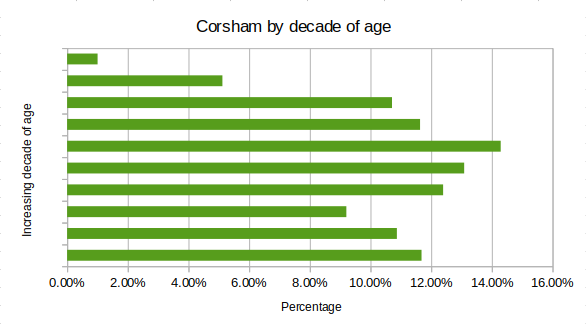
under 20: 3002, 20-39: 2810, 40-59: 3713, 60+: 3820
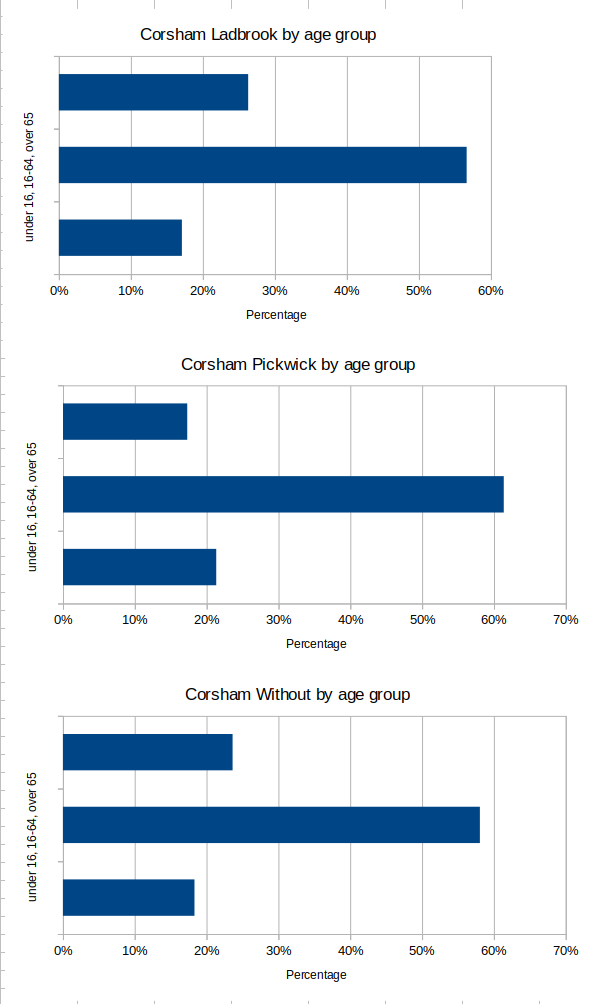
59.7% working age (15-64), 22.6% retired
Summary of Census 2021 statistics, 'Greater Corsham' inc. Neston (accessed 4 Mar 2022): https://www.citypopulation.de/en/uk/southwestengland/wiltshire/E35000414__corsham/
49.3% Christian, just slightly ahead of no religion
population change 2001-11: 17.9% (compare Chippenham 7.89%, Box: 4.80%)
population change 2011-21: 7.4% (compare Chippenham 2.09%, Box: 7.07%)
Filterable downloads of Census 2021 data (accessed 4 Mar 2022): https://www.ons.gov.uk/datasets/TS030/editions/2021/versions/2
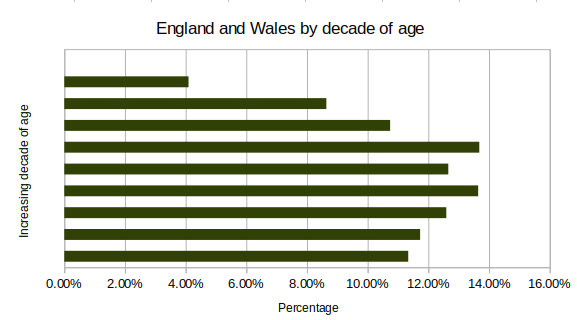
Some graphs prepared from this data:
Church of England parish data, Corsham: https://cuf.org.uk/parish/550132
Corsham Churches Food Bank: https://corshamchurchesfoodbank.org.uk/
Baptist Union, Five Core Values (accessed 4 Mar 2022): https://www.baptist.org.uk/Publisher/File.aspx?ID=117271
Corsham Baptist Church most recent return to Charity Commission including Trustees report as well as financial accounts (accessed 4 Mar 2022): https://register-of-charities.charitycommission.gov.uk/charity-search?p_p_id=uk_gov_ccew_onereg_charitydetails_web_portlet_CharityDetailsPortlet&p_p_lifecycle=2&p_p_state=maximized&p_p_mode=view&p_p_resource_id=%2Faccounts-resource&p_p_cacheability=cacheLevelPage&_uk_gov_ccew_onereg_charitydetails_web_portlet_CharityDetailsPortlet_objectiveId=A11975519&_uk_gov_ccew_onereg_charitydetails_web_portlet_CharityDetailsPortlet_priv_r_p_mvcRenderCommandName=%2Faccounts-and-annual-returns&_uk_gov_ccew_onereg_charitydetails_web_portlet_CharityDetailsPortlet_priv_r_p_organisationNumber=5030013