The Epic of Eden
Sandra L. Richter
- 29 minutes read - 6000 wordsIntroduction
Most people have a hodge-podge of knowledge of the old testament but no coherent structure. Richter suggests there are three reasons for this:
Never been taught the OT is their story. Both story and God different to the NT and to Jesus, even unnecessary.
OT is inaccessible for historical, geographical, cultural, linguistic etc. reasons.
The 'dysfunctional closet syndrome'.
OT as your story
OT is two thirds of the Bible and redemption story but treated as 'unfortunate preface'. Yet the characters are unknown to us as close relatives may be to an Alzheimer’s sufferer.
Outline: - chapter 1: culture of OT - chapter 2: redemption in real time and space - chapter 3: theology of that redemption in ch. 2 - chapter 4 (and following?): the actual story - chapter 5: the redemptive arc back to Eden (the New Jerusalem) - chapter 6 and following: each of six covenants
The dysfunctional closet syndrome
Net result is either spending outrageous amount of time to pull together respectable sermon or rely on a couple of old favorites. Hence the goal of the book is to bring order out of chaos and 'recognise your own story in the sweeping epic of redemption.
Chapter 1: The Bible as the story of redemption
Quotes anthropologist Darrell Whiteman that '[the average human] is scarcely a fish who would recognise water'. In other words, we mistakenly assume all cultures to be like our own: enthnocentrism.
For example, Western artistic depictions of Jesus as white, blond hair and blue or green eyes. Seeing Jesus as 'one of us' is not solely bad but we need also to see the OT world through eyes of OT people.
Secondly, we canonise culture, losing the distinction between the gospel message and the messenger. As evidenced by the culture such as clothes, music and liturgy, as well as gospel exported by many missionaries.
The word redemption
Has become Christian jargon and thus meaningless. So what does it mean?
Tracing back through NT Luke 1:68, 1 Pet 1:18-19, Gal 3:13 to OT Isa 43:1 to non-theological meaning (Hebrew _ga’al).
Israel’s tribal culture
Categorises modern Western culture as 'bureaucratic'. Family is peripheral to the state.
Contrast the importance of family as central axis of tribal community. Access to legal and economic rights was through the patriarch who was responsible for them.
Patriarchal, patrilineal and patrilocal.
Patriarchal
Quotes Marshall Sahlins that society is a 'progressively inclusive series of groups'.
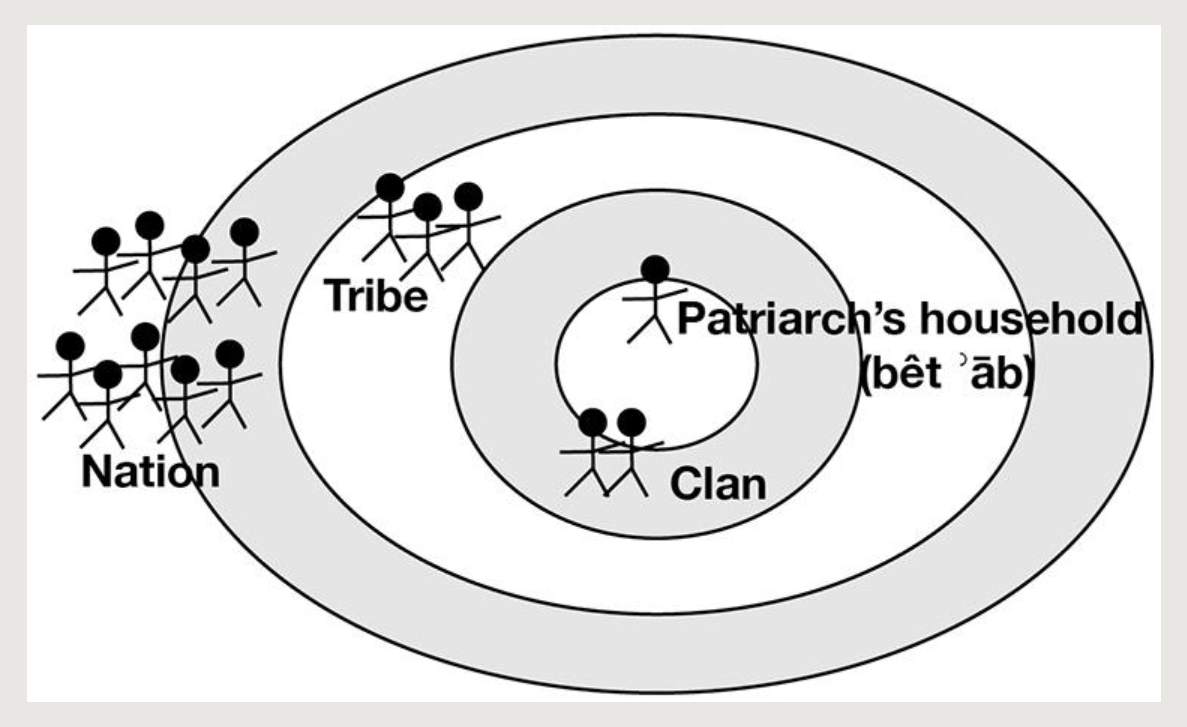
Men, on marriage, remained part of father’s house, women transferred into husband’s tribe (see Gen 24 for example of Isaac and Rebecca).
Bet ab denotes fathers household, typically up to three generations, perhaps thirty people. Those outside where without protection. Yet, OT shows frequent concern for 'widows and orphans', e.g. Deut 10:17-18). In this light see Gen 38 for story of Judah not fulfilling his role of patriarch to Tamar though expectations continued that he should in seeking his judgement of her v24. When her deception was revealed Judah recognises his own guilt (at last) declaring her more righteous than him.
When patriarch dies or bet ab (pronounce betabv) becomes too large the oldest male(s) would lead a new household(s). That is why Abram is accompanied by his nephew lot (Gen 11:26-32) and why they part in Gen 13:5-6.
Patrilineal
Family line passes to the eldest son who was more important during his father’s life (Gen 43:33) and received a double inheritance on his death (Deut 21:17). Hence genealogies including women are remarkable and worth investigating.
Jesus' genealogy in Mat 1 is one such, introducing Christ as coming for the sinners and foreigners (Rahab, Ruth, Bathsheba).
Consider too the counter-cultural impact when God chose younger brothers in Jacob, Judah and David.
'people look at the outward appearance, but the LORD looks at the heart' — 1 Sam 16:7
Examples of provision for widows: - 'Gleaning' laws in Deuteronomy 24:19-21 - Widow without offspring should marry surviving brother and first son is heir not to the living brother but the dead one receiving his inheritance and care of his mother; Deut 25:5-10
Land laws: - Yahweh distributed land to the various tribes - Dire circumstances might lead to sale but this was not permanent (Lev 25:1-28) provides to repurchase or be returned in the year of jubilee. Richter asserts evidence for repurchase though no evidence either way for jubilee.
Patrilocal
Tribal living more akin to a family compound aligned to the bet ab. Archeological evidence for numerous common spaces such as courtyard, oven, vineyard. Individual homes for nuclear families were pillared two-up, two-downs. Fig. 1.2 shows an excavated floor plan, fig 1.3 an artist’s reconstruction. Richter cites Lawrence Stager’s proposal that Luke’s stable and manger of Jesus' birth may have been the animal’s space within the family house.
Conclusion that these features provide solidarity in the face of harsh conditions (highlands and Canaanite foes).
Archeological evidence for a first, quick burial then reburial once flesh had decomposed in the family tomb. Supported in Biblical stories (Gen 23:1-20, 25:9-10, 49:29-32) as well oaths to take bones of ancestors from Egypt (Gen 47:30, 50:25) when they leave.
Jesus in Patrilocal culture
Interpretation of John 14:1-3 as Jesus describing heaven as a family compound as that above.
Redemption in the Bible
Redemption, as noted above, first initially a secular term that describes the patriarchal responsibilities to the wider bet ab.
Ruth and Boaz: Boaz agrees to become Ruth’s go’el (kinsman-redeemer)
Lot and Abraham: When Lot taken captive in Sodom (Gen 14) Abraham is responsible for redeeming him.
Gomer and Hosea: Hosea a man of standing, Gomer quite the opposite, called to be a living metaphor to the nation’s faithlessness from which Hosea is called to redeem her. Repeatedly.
Conclusion
This patriarchal responsibility then is what gives birth to redemption as a theological term: Yahweh as patriarch come to redeem his lost family; for his son to pay their ransom and share with them his inheritance.
We are restored to the bet ab, the household, brothers and sisters, of faith.
Chapter 2: The Bible in real space and time
Richter proposes a structure based on five eras each represented by a single individual.
Adam - Genesis 1-5
Rejection of God’s plan in favour of human autonomy. > 'Not dateable events'
Genealogies in the OT tribal context not intended as record of every generation but more fluid, each constructed to make a societal point.
For example, Mat 1:2-17 has two blocks of 14 generations; Luke 3:23-38 has two blocks of 21. Just different. Though Richter does not offer interpretation of what Luke was aiming at.
Richter offers several examples of numerical significance in the Genesis genealogies.
Noah - Genesis 6-11
Denotes achievement of 'true civilisation' by humanity—a long time.
An 'epoch divider', 'critical to redemptive history'
Abraham - Genesis 12-50
TODO remainder of ch 2
The language and features of a covenant
The vernacular of 'cutting' a covenant was often ritually ratified, and illustrated, by sacrifice of an animal. The sacrifice also provided a metaphor of the 'cutting' of the vassal who broke the covenant. Jer 34:18-22 even speaks of walking between the sacrificed parts - 'a powerful visual aid', quips Richter.
Gen 15.8-15 provides the example of God reaffirming the, as yet unfilled, promise of a child to Abram by sacrifice and dream. - 'deep sleep' echoes Adam when God created Eve - 'deep' or 'impenetrable' darkness often denotes theophany - Lexham Bible Dictionary & Miriam Webster both reference _visible but Richter chooses physical appearance.
Richter also reads into the text that God, the stronger as opposed to weaker party to the covenant, 'passed between' the sacrificed halves. Proceeding from there, she asks who paid the price for Abram’s descendants' faithlessness to the treaty? And concludes it is not the Israelites but Jesus' who is bloodily sacrificed.
The final characteristic of bĕrît identified is that the vassal’s response to the suzerain’s blessing is to love him: the exact mirror of the relationship between Yahweh and Israel.
The form of bĕrît
Evidence drawn from second millennium BC Hittite suzerain/vassal treaties:
preamble listing names for the great king
historical prologue the basis for gratitude of the vassal; notably absent from 1st C. Assyrian treaties
stipulations required of the vassal
blessings for meeting the stipulations
curses for breaking the stipulations
witnesses to the covenant
deposit of the record in the temple of the deity covenant sworn by
periodic reading of the treaty to remind the vassal
The bĕrît of Mount Sinai
Important comparison of Bible to Hittite treaties by George E. Mendenhall, 1954.
The Exodus 19:1-23:19 and Deuteronomy covenant matches the Hittite formula.
Yahweh did not create the covenant idea ; he co-opted it to communicate his plan of redemption.
The exodus was the physical and very real implementation of covenantal redemption described in 1 Pet 2:10:
Once you were not a people, but now you are the people of God; once you had not received mercy, but now you have received mercy.
Chapter 3: The concept of covenant
The 'general law' guiding the OT writers—theologians—in structuring the book(s) is the concept of covenant. It is not haphazard.
Covenant, like redemption, is a jargon that consequently loses meaning. From Hebrew bĕrît, definition very similar to 'contract' in English. Could be between: - individuals (Gen 24); - tribe (Gen 26:26-33); or - nation (Josh 9-10)
Fictive kinship
Refer back to ch 1 for the greatest privilege and also responsibility of the eldest male in the tribal culture. So how to relate to non-kin? Make them kin by 'fictive' (fictional) kinship sealed with oaths.
Covenant making in the ancient Near East
Dozens of petty kings and kingdoms sharing the area we know as Israel, Canaan or Palestine, hard to demarcate. Contrast with super powers of Egypt and Mesopotamia. Many treaties to navigate this political, economic and military minefield: - Parity treaties (between equals) - Suzerain / vassal treaties (imposed by strong states on weaker ones)
The former is of the brothers / fictive kinship kind. The latter, interestingly, also relies on family metaphors, but more of father-son or lord-servant. These always included military protection and often established by gift of land so the vassal effectively owed everything to the suzerain.
Multiple parity treaties were acceptable but a vassal could only have a single suzerain. The vassal’s loyalty is termed hesed in Hebrew.
Joshua 9-10 describe the trick of the Gibeonites to make Joshua into their suzerain lord and their existing parity partners naturally see this as treacherous so march together against them (Josh 10:5). But Joshua is now in the position of being expected to protect them! Even though JOshua had made the treaty without consulting God, God gives him the victory (Josh 10:7-10).
As well as Biblical references, there are comparable covenants found in near eastern inscriptions.
The language and features of a covenant
The dating dilemma
When did Israel assimilate the covenant tradition.
So standardized that an individual bĕrît may be dated by its literary form
Absence of historical prologue and blessings from first millennium Assyrian covenants and presence in both Biblical and second millennium Hittite covenants supportive of that dating for Deuteronomy.
Conclusions
'Through the bĕrît at Sinai, Israel’s self-identity was transformed from aggregate to nation.'
Yahweh introduces a wealth of theology far beyond their understanding:
Monotheism
Vassal status of Israel
law
calendar
blessings in return for 'loving' Yahweh (and his covenant)
curses for 'rejection'
Both chronology (ch 2) and now theology organised around 5 characters each mediating a covenant between God and people.
Chapter 4: God’s original intent
Eden was the original intent, and although no explicit bĕrît Isreal’s self-understanding so influenced by it that the early Bible narrative (i.e. Pentateuch?) structured that way.
Yahweh: suzerain
Adam and Eve: vassals
Blessings and territory: Eden
Stipulations: few, and simple: 'don’t eat from the tree of knowledge' but summarises everything: 'God it God and we are not'
Curse for treason: death
ASIDE: Chapter and verses introduced by Archbishop Stephen Langton in 13th C.
Genesis 1: story of creation v1 (actually finishes at 2:3 or 4 according to diff scholars)
Genesis 2: story of creation v2
Clearly complimentary though different emphases:
Gen 1: transcendence of God
Gen 2: anthropomorphic
Richter identifies ch 2 as part of the 'folkloric' genre that continues to ch 11. Ch 1 is, she says, a 'grand introduction' and 'lens' to see the rest of the Pentateuch, and by extension, Bible through. A theological introduction to explain who God is and our relationship to him.
The 'week' of Genesis 1
Several interpretative theories:
The 'gap' or reconstruction theory
From Schofield’s annotated Bible (a key source of dispensationalism and its popularity in 20th C USA).
Bizarrely, he proposes that Gen 1:1-2 should actually read:
In the beginning God created the heavens and the earth. And there was war in heaven, and Satan and a third of the angels waged war against God and his angels. And Satan was defeated and cast down to earth, and as a result the earth was [became] formless and void [Hebrew tōhû wābōhû], and darkness was moving over the surface of the waters.
(extrapolating from Isa 14:3-23, Ezek 28:11-19 and Rev 12:12).
Thus Gen 1 is six days of re-creation. This rests on two motivations: 1. The Hebrew tōhû wābōhû ("formless and void") is used elsewhere to mean destruction leading to formlessness, not merely a blank canvas. - The re-creation idea provides for an earlier time that can then accommodate all the fossil record.
Geological era theory
This relies on the fact that the Hebrew word for day (yôm) can sometimes be an undefined span of time, by interpreting each day as a long 'era' of undefined length. But this is still problematic due to the ordering, for example: the sun is created before the earth.
A better interpretation is that Genesis is just not written to explain such things. The metaphor of reading a car handbook to find where your winter clothes are ridicules any such attempt.
The literal or twenty-four hour day theory
The easiest interpretation—that is what the Bible account says—though there are many challenges from science and for that matter logic (how to measure the first three days since light does not arrive until day 4?)
Richter asks what might the author have been trying to communicate with the seven day approach? Noting the poetic style, refrain after each day and differences on day 6 (longer=significant?) and day 7 ([unspcified] Hebrew symbolism, not least Sabbath)
The framework theory
First articulated by Augustine in 'On Genesis according to the literal sense'. Described by Richter as 'a literal week' but used as 'a literary device'. I understand this as a metaphor of a literal week, Richter is vague suggesting the week is in some way an organising structure as one might use in a photo album, before presenting Figure 4.1, which she says signifies progress towards a goal.
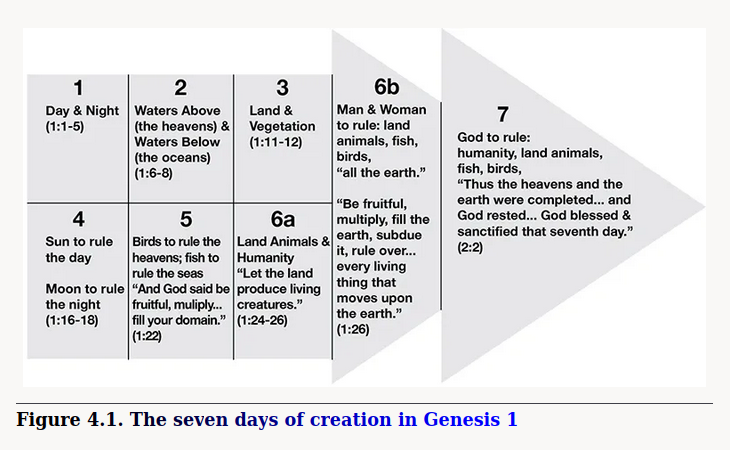
Terminology explained: - Waters above: Ancient Middle-East cultures understood the sky as a barrier holding back water, when the windows where opened, it rains. - Waters below: The primordial deep—a frightening thing associated with chaos—but reassuringly something God has power over. - Days 1-3 denote the habitat, 4-6 the inhabitants, setting up a parallelism. - Day 6b sets up man and woman as God’s stewards of his domain. - Day 7 shows the perfect completion of God’s perfect plan.
Eden as covenant
Overtones of suzerain-vassal pretty self-evident by this stage.
Consider the Sabbath
Rest (in Hebrew typically nûaḥ) was something that conquering kings had and did when their enemies were defeated and their domain was fully under their control.
The implication is that God’s plan is complete (chaos is vanquished, order established?) and He rests in it. But in Gen 2:2-3 rest is not nûaḥ but šābat. This draws to mind the precious gift of a day off to the newly freed slaves in Exod 20:8-11. Our workaholic culture may be more self-imposed drive than driven slaves but the point still resonates.
Adam’s choice
Did ʾAdām want [God’s perfect] world? … The ones made in the image of God could not be forced or coerced, but instead were called upon to choose their sovereign.
The curse of the covenant-breaker that 'you will surely die.' (Gen 2:17 NIVUK) is not delivered immediately but deferred and His own Son substituted. But the blessings are certainly reversed.
The image
ṣélem (Gen 1:26-27, Gen 5:3, 9:6) is the word for what a polytheist of the age is making when he crafts a representation of his god. We may understand God as a creator / crafter and that the idol is inanimate unless animated by God in this usage.
Key points: - plural 'let us make': God is, and humanity was made for, relationship - rule: Adam and Eve have dominion—under God - distinct from animals - sharing some likeness with God: perhaps as a parent-child likeness. Perhaps including radiance in their pre-fallen state (refer Exod 34:29-33, Ps 104:2, Isa 60:19, Matt 17:2, Matt 28:3, compare Ps 8)
Eve
The pain and very real risk of death spoiling the wonder of birthing a child
The transformation of 'co-regency' with Adam to competition and rivalry for now-scarse resources.
Adam
Adam (ʾādām) had been created for the ʾădāmāh ("cultivatable land"). Struggle and toil for even a diminished return 'The sweat of your face' Gen 3:19 arises not from labour but fearful anticipation says Richter citing an article by Daniel Fleming of New York University. As in: Where is the next meal coming from?
Loss of the presence
Therefore the LORD God sent [šālaḥ] him out from the garden of Eden.
šālaḥ is the same word as for divorcing a wife or disowning a child, says Richter.
Seven days turned upside down
Richter revisits Figure 4.1 above noting how when Adam and Eve usurp Yahweh’s ultimate authority each part is disrupted and broken apart. The choice to do this was theirs, but not the agency to hold everything together having done so. Romans 8 directly addresses this fractured world and longs for its restoration in Christ.
Humanity’s losses: - distant: such as the cherubim keeping us out of Eden, but also… - direct: the gradual degradation of our bodies as the year’s pass.
Why do bad things happen to good people?
There is a widespread understanding that something is wrong when babies die, dictators thrive, terrorism spreads. Richter’s answer: 1. There are no good people (she acknowledges people find this shocking) 2. 'this world is at war with itself'. Once good, it no longer is, bad is normal and intrinsic.
Conclusions
A perfect world covenanted to Adam and Eve but the covenant broken.
The only hope comes from God in His plan for redemption.
All the first Adam lost, the second Adam bought back.
Chapter 5—God’s final intent
Exiled from Eden, now what?
The iconography of Eden: Of Cherubim, trees and rivers
Cherubim
The fearsome creature preventing any return to Eden, armed with a double-edged sword. Genesis 3:24
Part of the design for the tabernacle: Exod 25-26 and 36-37.
From symbol of exclusion to decoration of both Tabernacle and Ark, whose purpose it to allow God to live amongst His people.
Richter reads into this a father’s longing to be with His children, though also says she may be being sentimental.
Both acting as guards though.
5and in the fire was what looked like four living creatures. In appearance their form was human, 6but each of them had four faces and four wings. 7Their legs were straight; their feet were like those of a calf and gleamed like burnished bronze. 8Under their wings on their four sides they had human hands. All four of them had faces and wings, 9and the wings of one touched the wings of another. Each one went straight ahead; they did not turn as they moved. 10Their faces looked like this: each of the four had the face of a human being, and on the right side each had the face of a lion, and on the left the face of an ox; each also had the face of an eagle. 11Such were their faces. They each had two wings spreading out upwards, each wing touching that of the creature on either side; and each had two other wings covering its body. Ezek 1:5-11
6bIn the centre, round the throne, were four living creatures, and they were covered with eyes, in front and behind. 7The first living creature was like a lion, the second was like an ox, the third had a face like a man, the fourth was like a flying eagle. Rev 4:6-7
Richter reports some modern scholars believe these animal traits may represent strength, speed and sagacity.
They are common enough symbols in ancient statuary including on columns of Neo-Hittites, the Sphinx in Egypt, and guarding Assyrian throne rooms.
The Eden and Tabernacle uses too may be seen as guarding God’s throne room.
Trees
As Israel became more settled David thought of a more permanent version of the tabernacle, which it was Solomon’s role to build. 1 Kings 6:29-35 Similar to the tabernacle, but 'amplified', both larger and trees, flowers and fruit added to the cherubim. Echoes of Eden.
Rivers
Ezekiel 47 Situated within the larger vision of restored temple (Ezek 47) Ezekiel’s vision of the restored temple has grown to encompass all Jerusalem. Richter identifies the square temple in the vision (Ezek 48:35) with the fact that only the Holy of Holies in Solomon’s temple was square. In other words the place God actually dwelt has expanded to encompass where ordinary people live. The vision also introduces a river that restores both desert and dead sea, but not the marshes as they were 'an important source of income in Ezekiel’s day!' says Richter. Ezek 47:12 brings to mind Eden and its Tree of Life.
The New Jerusalem
…there is no longer any sea. — Rev 21:2
Recall sea equates to chaos and rebellion. Heaven, not somewhere in the clouds, but a perfected Earth in the presence of God. Heaven is Eden: a lush paradise but now additionally containing the city 'built in our fallenness' now redeemed and perfect.
no temple (God and humanity can now co-exist)
no sun or moon (illuminated by the glory of God)
no gates (no threats)
no night (similar to the no sea above)
God’s final intent
Is the self-same as His original intent: Humanity in the presence of God in Eden.
Eden-past is actually our best picture of what heaven-future will be.
A metaphor of a rock-climber falling out of Eden and too injured to help himself, first aid administered (Abrahamic covenant) airlifted to hospital (Mosaic covenant), operations (Davidic covenant) and in ICU (New Covenant—Jesus), but will he recover (finish the race in Paul’s terms)?
Then introduces the six covenants:
Adam (pre-fall): the intended relationship
Noah: restored contact with God
Abraham: begins restoring humanity to be God’s people (His possession)
Moses: nationhood and citizenship established; the presence of God restored in a limited way
David: an ideal vassal, a 'prototype' of the real messiah to come (foreshadowing seems more appropriate to me).
Jesus: 'already, but not yet' with New Jerusalem the final fulfillment
Two similar progressions are offered illustrated in Figure 5.7:
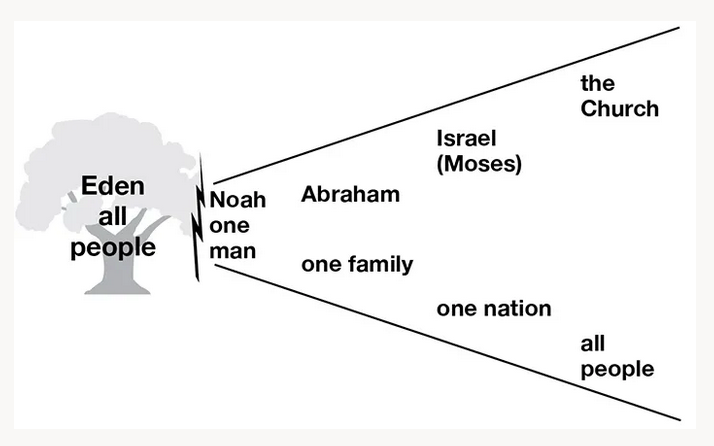
and Figure 5.8:

Conclusions
What went wrong in Eden is what must go right in redemption; what was done in the garden must be undone in Christ.
Guilty both of Adam’s original sin and in choosing to follow in his footsteps. Necessitates deliverance on both fronts too: Jesus to stand in for us and not sin as Adam did and 'to be somehow lifted from our depravity long enough to say "yes" to God'
Chapter 6: Noah and Abraham
By means of Noah’s covenant, God redefines his relationship with humanity for the first time since Eden. With Abraham, the re-identification of people and place begins.
Noah and the recreational covenant
Post Eden: 'every inclination…only evil continually…corrupt…filled with violence.' [Gen 6:5-6,11] Noah and descendants the exception: 'righteous…blameless…walked with God' [Gen 6:9] Noah, means “rest” (Hebrew nōaḥ; cf. Gen 5:29)
Noah’s real time: Richter proposes actual time from Adam to Noah is thousands of years: - humanity has multiplied to the point that civilisation rose and declined. - Mat 24:37-39 compares Jesus time to Noah’s and similar corruption must take similar time [?!]
Noah’s real space: Mesopotamia between the Tigris and Euphrates. Known to be both 'thoroughly urbanized' and subject to 'catastrophic flooding' Quotes finds of 12' thick flood depositor found during 1920’s excavation of Ur by Sir Leonard Wooley, dated to middle of 4th millennium BC. Also archaeological evidence of 3rd C floods of Kish and Shuruppak Several local stories of 'epoch dividing' floods, most notably the Epic of Gilgamesh. Richter adds that some of these stories have heroes who save a single family (and animals) as well as antediluvian kings reigning for periods of many thousands of years whilst this dramatically reduced after the flood. Compare long lives—as opposed to reigns—reported in Genesis.
Note | David Firth discussed such creation stories being repurposed to contrast the capricious local gods with Yahweh. |
Richter concludes that similarities across more than one people group lends credibility to the history.
The flood recalls the chaos pre-creation when waters below (tĕhôm) and waters above were untamed and 'the earth was a formless void' Gen 1:2 And similarly Job 38:8-11 Far from the cute picture of pairs of animals boarding the ark, this is a devastating and frightening picture.
More comparisons and contrasts between various Mesopotamian stories and the Bible. Questions about how much God’s people is absorbing the world-view around and how much is God correcting in terms they can relate to.
The next milestone in redemption is Moses—who is rescued from the Nile where he floats in an 'Ark' (tēbat)--and leads them out of Egypt and rescues them from the chaos of the Red sea that consumes pharaoh. Joshua leads Israel into the Promised Land thru the parted waters of the Jordan And Jesus saves his fisherman friends from drowning in Lake Galilee [Not to mention rising to life from 'the deep' waters of baptism at the Jordan.] Peter explicitly links this victory over water (metaphorically chaos) with our own baptism in 1 Peter 3:18-22. Finally in the famous line from revelation of a new heaven and a new earth we see the less often quoted conclusion 'and the sea was now more'
The re-creation: After the 'de-creation' of the flood, God blesses Noah instructs him to be fruitful and multiply, and gives everything into his stewardship in an obvious echo of Eden Gen 9:1-4. A difference exists too, Noah may eat flesh as well as 'every green thing'. Richter suggests that the 'lifeblood' claimed by God is Gen 9:5-7 more to protect animals from man than man from the animals. Covenant is established through the rainbow Gen 9:8-16
Note | 'Bow in the sky' a symbol of peace to subjugated people. Held reversed to signify peace, but may be easily returned to the offensive if the peace is broken. Reference The Black Obelisk of Shalmaneser III at Room 6 of the Ground Floor of the British Museum, London. You don’t make peace treaties with your friends. |
chesed: loving kindness, grace, faithfulness—the response from the vassal to the suzerain.
The curse of Canaan, son of Ham, son of Noah: Though it is Ham who disrespects his father it is Canaan, who is cursed. And he is the ancestor of the peoples Israel will later drive from the Promised Land.
The sons of God and the daughters of men: Gen 6:1-4
Fallen angels (Nephilim from nāpal, 'to fall') mating with human women to produce super-heroes in the mould of Heracles or Achilles. Or
Human royalty pairing with commoners polluting God-ordained leadership. Or
Male descendants of Seth and females of Cain’s line—proposed by Calvin—also bearing corrupt offspring.
Richter supports John Sailhamer in reading Gen 6:1-4 not as the prologue to the flood but the epilogue to the Adamic age.
In this reading, the Nephilim are not fallen angels but infamous warriors, wreaking havoc, who fell by the sword.
And the procreation the expansion that we are about to see referenced in the flood, along with their unpreparedness for judgement that Mat too cites in his comparison of Noah and Jesus.
Note | Gordon Wenham has described Gen 6-9 as a gigantic palistrophe. [A poetic form that reflects itself in the second half] |
Abraham, the father of the Jews
The chosen line continues with Shem—ancestor to all Semitic peoples—as recorded in the genealogy of [Gen 11:10-28] Richter reminds us she identifies this as the start of 'dateable history' and this is accompanied by a genre change. After re-introducing himself to humanity God is now developing a relationship with a real people in a real place and real time.
Abraham’s real time: Around 2000BC, which aligns to a major upheaval in Ur III civilisation. But these things should be held loosely. What is known of Middle Bronze Age Canaan (MB II) is strikingly similar to the pastoral existence of the patriarchs found in Genesis. [cites Israeli archaeologist Amihai Mazar]. Amurru people group, known as Amorites.
Abraham’s real space: Following the Euphrates from Ur to Haran, where Terah dies, then on to Canaan.

Richter says most people in Abraham’s day would no more up and leave their homes than people today but surely that is to ignore that Abram took his entire family and wealth with him. Anyway '[God] credited it to [Abram] as righteousness' Gen 15:6, NIV
Abraham’s covenant:
Rather than a suzerain-vassal covenant as in chapter 3, Richter describes this as a 'royal grant' to an individual—akin to patronage—and in perpetuity. Reiterated and clarified heir will be 'from your own body' in Gen 15 in response to Abram appointing his servant as his heir. ASIDE: Galatians 3:1-9 belief credited to NT believers just as for Abram. Gen 17: Abram again takes matters into his own hands and again God reiterates his promise, this time accompanied by a name change. The change of name to the people of the time is a common symbol of being promoted to a new role, and to us a symbolic elevation to the role of a new Adam and Eve.
Circumcision: Not new—examples in Egyptian inscriptions—but new to Abraham. And different in being applied as a marker of being part of the nation soon after birth rather than denoting transition to manhood, priesthood, marriage or anything else. Applies (symbolically) to women too: Gen 17:7.
Conclusions
As with the sideways V in Longman, Richter concludes the developing covenant as being: - Noah: 're-establishing contact with humanity - Abraham: expanded to permanently welcome one family, but now including descendants in perpetuity.
Chapter 7: Moses and the tabernacle
Typology vs allegory: - Typology from typos - Types is a 'limited fulfilment', says Richter. - Firth also happy with 'pattern' - Analogy to flight of the phoenix, model plane engineer does know all he needs to build a full size version. If Paul allegorises in Galatians 4:21 is that what we should do to? - many have argued so, but no. allegories are madness because anyone can make anything into anything Discussion of Esther: - could we read the banquet as a twisted version of a future heavenly banquet; gallows etc? - Firth: Inter-textual reading - Esther 2:5 → 1 Samuel 9:1 - Mardechaih assopciated with Saul - Mordekah greater than Saul because he does what Saul did not. - Esther 3:? → 1 Samuel 15 - Agag - setting up Esther as typology of earlier conflict between Yahweh and Amalek - idiom: 'the money is given to you' https://www.bible.com/en-GB/bible/2016/EST.3.11.NRSV in fact means, 'thanks put it in the coffers'. - 13th day of first month is the day of preparation https://www.bible.com/en-GB/bible/2016/EST.3.12.NRSV - this links Esther to Exodus and from Exodus may link to Jesus, since Exodus is type of Jesus redemption.
Chapter 8: David and the monarchy
Chapter 9: The New Covenant and the return of the King
Oct 30, 539 BC Cyrus the Great occupied Bablyon and allowed the Jews to return home as had been prophesied (Isaiah 40:1-11, 45:1-7, Jeremiah 25:11-13, Ezekiel 37:1-14). Very few chose to return and their rebuilding was nothing to the Davidic dynasty. They were now a subject province iknown as Jews not Israelites and spoke Aramaic. Synagogue (rather than Temple) worship, Rabbinic 'fence around the law' social boundaries and priests rather than kings as national leaders were all forging what we now know as Judaism.
The return of the King
Prophecies:
A shoot will come up from the stump of Jesse; from his roots a Branch will bear fruit. In that day the Root of Jesse will stand as a banner for the peoples; --Isaiah 11:1,10, NIVUK
For to us a child is born, to us a son is given, and the government will be on his shoulders. And he will be called Wonderful Counsellor, Mighty God, Everlasting Father, Prince of Peace. Of the greatness of his government and peace there will be no end. He will reign on David’s throne and over his kingdom, establishing and upholding it with justice and righteousness from that time on and for ever. The zeal of the LORD Almighty will accomplish this.
NIVUK
'Predictably' interpreted as national, and presumably military, leader. All knew this leader would descend from David and Abraham. Hence Matthew opens with the genealogy—this is the one!
Matthew 1:20-21 (angel reassures Joseph about Mary in a dream). Joseph dares to hope. Had anyone ever addressed this humble artisan by this lineage descended from David before?
I will raise up your offspring to succeed you, your own flesh and blood, and I will establish his kingdom. your thone shall be established for ever. 2 Samuel 7:12,16
[This may be read as speaking of Solomon at first glance. And perhaps it is in part. But the establishment forever cannot sit with that reading since David’s line would be interrupted by the exile and only restored in Jesus.]
OT kingship proclaimed by public anointing with oil (representing the Holy Spirit). The verb māšaḥ from which we get Messiah. Richter refers to John the Baptist baptising Jesus in terms of 'new wine in old wineskins' since the OT annointing identifies the New Covenant king. Not to mention heaven opening and the voice proclaiming the king’s coronation [Richter’s metaphor].
'The type of the Davidic king is fulfilled in the coming of the man Jesus' [my emphasis in light of Firth’s stressingn of typology last week]. Immanuel (Hebrew immanû-ʾēl) 'God with us. …the Presence come to 'tabernacle among us' (Jn 1:1, 14).
Jesus the ultimate covenant mediator
one mediator between God and mankind 1 Tim 2:5
And not just to the Jews but to all humanity (John 3:16) Ultimate solution, ultimate breadth.
So where is the kingdom of God?
Why still subject to Rome? Why no throne in Jerusalem? What about the Abrahamic boundaries?
Matthew 13 parables: Kingdom is like… - v24-30: Wheat and tares (weeds) grow together until harvest - v31-32: Mustard seed - v33: Yeast
The principle of 'now and not yet' [Richter says 'already…'] Already: 'born again' [1 Peter 1:23]; sealed with the Holy Spirit [2 Cor 1:22], being conformed to His image [Romans 8:29] Not yet: This world has become 'the kingdom of our Lord and of his Messiah, and he will reign for ever and ever' Rev 11:15, NIV
The already
People: Not merely Abraham’s genetic descendents but all Place: No longer the nation of Israel, but all who live by faith (as Abraham did). Hebrews 11:8-10 Presence: No OT tabernacle or temple but 'tabernacling' with us, Jesus' body is the new Temple.
The not yet
People: New Jerusalem will be safe because none who do 'what is shameful or deceitful' will enter Rev 21:27 The gates will never be closed as there’s no need. Rev 21:25 Presence: New Eden, where 'God himself will be with [His people]' Rev 21:3, NIV
Conclusions
Full circle: from Eden to new Eden.